
As discussed in my previous post, the government’s Best Start in Life Strategy made a clear commitment: to grow the number of Early Years Teachers (EYTS) in England. On paper, this sounds like a step forward — recognition that graduates matter for quality, outcomes, and equity in early education.
But a long-standing debate remains unresolved: should we give EYTS parity with Qualified Teacher Status (QTS)?
The Debate in Brief
The EYTS recognises the distinct pedagogy of working with babies and young children, training professionals to support learning and development from birth to age five. It reflects the unique expertise required to work in nurseries, preschools, and reception classes.
Yet, unlike QTS, EYTS does not give access to teacher pay scales, qualified teacher roles in maintained schools or full professional recognition. The signal it sends is clear: early years teaching is somehow “less than” primary or secondary teaching.
This lack of parity has shaped the workforce for over a decade — with consequences we are still seeing today.
Recruitment Struggles
The promise of EYTS has not translated into strong uptake:
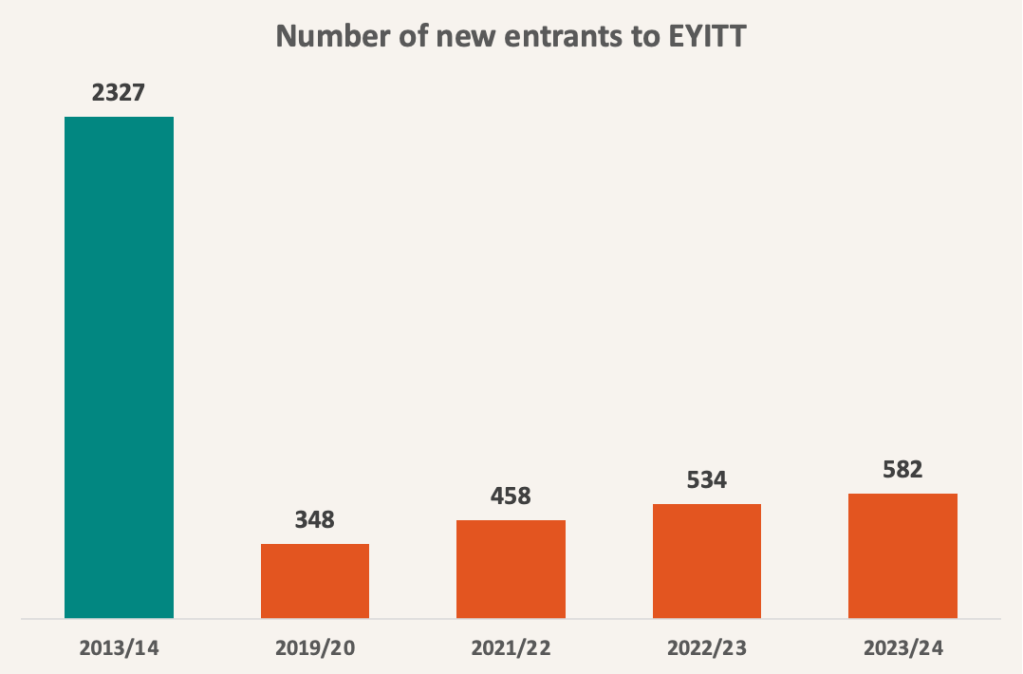
- Recruitment has collapsed since launch
New entrants to Early Years Initial Teacher Training (EYITT) have fallen by 74% since 2013/14
Targets keep slipping away
Even when government has reduced recruitment targets, providers continue to fall short. In 2023, EYITT recruitment dropped by 21% compared to the previous year, despite lower targets (FE News, 2023).
The result? In most PVI (private, voluntary, independent) nurseries, there is on average just one graduate per setting. Too few to raise quality at scale, too few to mentor colleagues, and too few to make a sustained difference for disadvantaged children.
Why Parity Matters
Evidence shows that graduate presence is linked to better outcomes, particularly for disadvantaged children attending for 30 hours a week (Bonetti and Blanden, 2020). Graduates bring:
- Pedagogical depth — grounding practice in child development and curriculum knowledge.
- Reflective practice and leadership — modelling and mentoring across staff teams.
- Professional credibility — giving the sector visibility alongside other parts of education.
But without parity, graduates in early years face limited progression and lower pay. Many either leave for primary teaching (via QTS conversion routes) or exit the sector altogether.
A Sector at a Crossroads
The government wants more graduates in early years — but the current model of EYTS is not delivering. The question is no longer just about recruitment targets, but about status, progression, and parity.
Do we:
- Upgrade EYTS to QTS — extending parity in pay and recognition, while maintaining specialist early years training?
- Or create a new graduate pathway — distinct from QTS, but with equal pay, status, and clear progression routes?
Conclusion
There are no easy answers. EYTS rightly reflects that working with babies and toddlers is not the same as teaching Year 2. But the current compromise satisfies no one: not providers, not graduates and certainly not children.
If the Best Start in Life Strategy is to succeed, it must grapple with this divide. Because without genuine parity — whether through QTS or a new graduate pathway — England will continue to miss targets, lose talent and leave children without the high-quality teaching they deserve.
Sources
 Sara Bonetti Research